Friday, December 5, 2008

English 212


What in your opinion is the center or most important aspect of this semester's work in "Writing About Visual Culture"?

God has blessed us with many gifts. One of the greatest gifts that majority of us posses is the gift of sight. With sight, we are able to appreciate the world around us; a world that is full of color, wonder, and majestic beauty. Another important gift is expression. The ability to express ourselves allows us to communicate in many ways; we can talk, use body movement, write, create art...the list is endless. The need to express is built into all of us, but the way we express is unique.

Expressions can be read many different ways. A picture painted by one person could mean something different to the audience. Our ideology, experiences, and education play a significant role in how we view and appreciate various texts. As our culture globalizes due to technology, we are exposed to more and more visual media. We see hundreds of different images every day, and I will propose that these images add to our “experience and education”, thus altering our ideology. It is irrefutable that media has an effect on us in one way or another, even if it simply educates us. An example of how media may affect someone would be a young girl who was constantly exposed to pictures of skinny women that are idolized. She begins to see herself with different glasses, and starts to believe that she needs to look that way in order to be beautiful.

English 212 stressed written communication and the analysis of visual texts, including still and moving media. Though the class was difficult, it challenged me to push myself. I feel that I have developed more as a writer, but I also find that I can appreciate visual texts of all sorts in a new way. For instance, I notice more when I watch a film than just the plot and the characters. I notice things such as gestures, blocking, camera movements, and added sounds. Though this class is not a part of my field of study, I feel that I have developed and strengthened certain skills that will be valuable throughout my career.

Saturday, November 15, 2008

Marriage


The secular meaning of marriage is “the state of being united to a person of the opposite sex as husband or wife in a consensual and contractual relationship recognized by law” (http://www.merriam-webster.com/dictionary/marriage). In this definition, marriage is little more than a contract that has no time limit; it can be broken at any time. I suppose this is why affairs and divorces, breaking of the contract, do not disturb most people the way they do me. To me, matrimony is a sacrament, a gift from God. It is “an indissoluble bond between a man and a woman, created by human contract and ratified by divine grace” (http://en.wikipedia.org/wiki/Catholic_marriage). Marriage is not temporary in my heart. It is a commitment between a man and a woman, and blessed by God. In this commitment, the two become one and are therefore inseparable until death.

When I read the article from ABC news, I was very bothered. Philip Victor discusses a divorce that was caused by a virtual affair on a site called “Second Life”. “Second Life” is a virtual world that people can create characters, or avatars, and interact in everyday activities. David Pollard was caught by his soon-to-be ex-wife Amy Taylor snuggling with a virtual avatar. Amy and David met and fell in love on line, so this is why it affected Amy so much. And now, David and the woman whose avatar he was with are getting married.

The shocking part of this story is the way the affair took place, not that he had an affair. That statement is a result of the desensitization towards affairs and divorces. Both are so prevalent in today’s society. The current divorce rates are as follows in America: “50% percent of first marriages, 67% of second and 74% of third marriages end in divorce, according to Jennifer Baker of the Forest Institute of Professional Psychology in Springfield, Missouri.”

It was only a matter of time until the virtual reality became a true reflection of our reality. If people are so quick to have affairs or end their marriages in reality, what stops them in a world of fantasy and bliss? According to David Brooks Overstimulated Surburbia, of the stories on the Sims game, most of them “don’t seem to regard marriage as the happily-ever-after ideal”. This is the trend in the modern world as well. Most view marriage as a binding contract in which they are constricted and restrained. For those of us who still view marriage as a sacred bond between one man and one woman, we become more and more troubled by those marriages ending in divorce. It is not the way God intended, which explains for the heartache and sadness that arises during and after the divorce process.

The article can be found on: http://abcnews.go.com/International/SmallBiz/Story?id=6255277&page=1

Saturday, November 8, 2008

R&D - Research and Development


When I began my research, I did not have a solid topic chosen. I knew that as a product of the technology generation, it has played and will continue to play an important part in my life. Children growing up now are exposed to more technology at an even earlier age. Most of their games and entertainment are technology based, and as we have more advances in technology, it will continue to consume a larger part of our lives. As with every aspect of our lives, the increase in technology will alter our lives and lifestyles. Is it possible that visual media could alter a person's personality and ethical decisions? Could it warp a child's conception of what reality is, and thus alter their conscious?

I began searching psychology databases on Saginaw Valley's website for academic journals that contained information about children being affected by media. In ProQuest Psychology Journals, I found an article by Edward L. Palmer and Brian M. Young called The Faces of Televisual Media: Teaching, Violence, Selling to Children. This is a scholarly journal and an academic article. It discusses the educational purposes of media and technology while contrasting it with its adverse effects of teaching aggressive behavioral patterns to children and young adults who play video games frequently. Though I do not know which conclusion I will establish, I know that I will represent the two instances and weigh out the pros and cons of media and technology’s role in our society.

The more popular site that I found for the relevant popular source was from http://www.businessweek.com/ap/financialnews/D944Q94O0.htm. I found this by typing “court cases, children violent video games” into Google search engine. Here it discusses a court case in which children under 18 years of age would be prohibited to buy or rent a violent video game without the parent’s permission. The court has yet to rule on this specific case, but the paper came out Oct 30, 2008. The ruling is said to come out in the next few months. It is interesting because it is being considered that video games are affecting the personalities of children and their behavioral patterns. I plan to continue researching similar cases to find more information. Another popular site to go in congruence with the educational television is found on http://www.medialit.org/reading_room/article119.html . The author provides information on preschoolers and young children who watched educational programming and scored higher on academic tests in the future.

Comparing and contrasting the positive and negative effects of technology is going to be my main focus. I hope to conclude which is more of an issue in our society, the disrupted behavior or advancements in education.

Monday, November 3, 2008

Real People - Real Campaigning

Political campaigning has changed completely in the last century. With the invention of new technology, the candidates were given new opportunities and new avenues of advertisement that otherwise would have been impossible. The addition of the radio and the television allowed political parties to share information and speak to every individual in America. Being able to see the candidate made a huge impact on the voters and ever since, has been a key way to address the citizens of America during a presidential campaign.

Due to the advancements in technology, voters began expecting more and more out of campaign advertisements. Candidates are always trying to make their billboard or radio advertisement or commercial better than the other guy’s. In order for people to pay attention to what they have to say, they have to use innovative methods to attract their audience.

As with all advertising, the audience usually feels most compelled by those commercials that they can relate to. This technique has been used since the 1950’s, according to Errol Morris in his article People in the Middle. The ads have “real people”, people that appear to be middle class and average. They use simple language and attempt to look sincere.

The problem with “real people” campaign ads is the fact that even these are altered and skewed. Take, for instance, the ad found on http://www.peopleinthemiddleforobama.org/. The people in the video are chosen out of thousands of people. They pick the individuals who are most appealing. They also pick snippets from each person’s interview and fuse them together. The more advanced our technology, the more altered the commercials are becoming. For example, one lady is cut off mid sentence and then fused with another sentence that she talked about later. The audience doesn’t hear her actual statement, but rather what the political party wants us to hear. It is not really “real”, but just as altered as any other commercial.

Regardless, these types of advertisements are effective. These “real people” ads are more of an ethos approach, trying to tug on the emotions of the audience. When people can relate to an advertisement, they are more likely to be affected by it and consider the message. Because the advertisements with “real people” are not informative, I believe that they must be used in addition to advertisements from the candidate themselves in which they discuss their political views.

Monday, October 27, 2008

Television & Technology


From an early age, my parents understood that the television was both a source of good and evil, though they never quite explained it that way. Technology has given us the ability as a society to communicate many different things quickly and efficiently. The internet, for example, holds billions of articles and academic journals, so much information that one person alone could not absorb it all. It is a key source of information and research, as well as a great way to communicate across long distances. Television has proved to be an effective way to relay information, but also to entertain. However, the overuse of technology can cause adverse effects as well.

When I was growing up, my parents never allowed my brother and I to watch television until our homework was finished. Many times, this meant missing our favorite television shows. She did not allow us to video tape them either. This was a way to stop any “addiction” we may have formed to a certain program, or maybe the television in general. All too often, children, and even adults, become consumed with starring at the TV, forgetting the world around them. They are absorbed in a false reality, neglecting their responsibilities and relationships. My parents helped us to understand in a subtle way that though the TV was an entertainment; it was not an addition to the family. The four of us needed to communicate and interact, not simply stare at a television screen.

Conversely, television can be a great way to have some family “downtime”. In the evenings, my family and I would watch a movie or a television show. Like in the picture above, we gathered together in one room and watched the same program or movie. However, this was after we had spent plenty of time discussing things about our day and what was going on in our lives. We did not let technology become more important than our family members. Our open line of communication is one of my favorite characteristics of my family.

Unfortunately, many families are losing this key ingredient. Many children spend more time on the internet, watching movies, or catching up on their program they missed to talk to their parents. This is, in my opinion, one reason children are having so many difficulties as they reach their teen years. They do not know how to talk to their parents. They have not established a relationship as a family and usually fall into temptations much easier. Technology is not the only problem, but when it consumes the life of a child, rather than the love from a parent, it definitely causes issues in the child’s life.

As technology advances and continues to take a higher position in the priorities of families as well as individuals, we will see our country reach a new low. Though technology can hold our hands and bring us into a new dawn of intelligence, that intelligence is powerless without the relationships and communication that’s essential to our existence. Restore the family, restore order. As long as technology, such as televisions, brings the family closer together, then it will find a place in my life.

Monday, October 20, 2008

Hitler & Triumph of Will


The aftermath of World War 1 left the German people desperate for strength, power, and unity. Their military power was demolished after the war. Adolf Hitler arrived at a time of despair and gave the German people exactly what they needed, a leader. As stated in Thursday’s lecture, “Hitler is the right leader for Germany at the time.” The documentary Triumph of Will also makes this claim, using key themes of religion, unity, and power for support.

The opening scene begins by a camera view from above the clouds. In addition to the music, Hitler appears to be god-like as he descends from the clouds upon the people of Germany. The people await his arrival, as the Jews awaited the arrival of the Messiah. Many viewed Hitler as a way to save the country from the destruction that they had endured earlier in the century. There are many scenes in which he addresses thousands of people and they all comply in unison. During one scene, Hitler compares the Nazi Party to a holy order and there is the “consecration” of the new party flags by Hitler touching them to the “blood banner”. These are obvious religious overtones that are powerful. Many Germans, as well as people across the world, practice in an organized religion. In many ways, Hitler compares his new Nazi Party to an organized religion, in which he is the center god-head.

Unification of a country is important to obtain peace and stability within a nation. The blending of the old tradition and new tradition are referenced many times throughout the documentary. The Nazi Swastika is shown next to the flag of the old German Empire (Imperial Germany). There is one scene in which Germans greet Hitler in old peasant costumes. Furthermore, there is a scene in which the men call off which city they are from. All of these images show how Hitler would hold sacred the old traditions of the country and build them in a new direction and how all of Germany would be united.

As previously stated, the German people had lacked military power and strength since the end of World War 1. Hitler’s regime of thousands of men marching together stirred up the passions of the German people. They believed, as Hitler hoped they would, that he was the key to restoring Germany to a world power once more. He gave them a new found hope, a hope that was lost to despair for so many years. He showed them how he was the light in a dark world, a light that could bring them from the darkness into the light. He told them that they would shine brighter than all the other nations.

Though we look back on his reign as a horrible and disastrous ruling, he appealed to his people. He promised them everything that they wanted from a leader, and everything they wanted for their country. It is this claim that Triumph of Will makes and supports throughout the documentary.

Monday, October 13, 2008

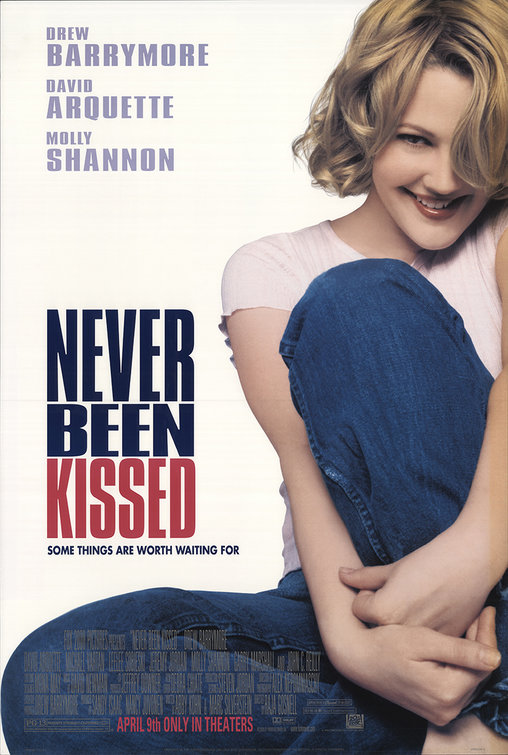
Never Been Kissed


The 1999 Film "Never Been Kissed" stars Drew Barrymore and David Arquette. In this movie, Drew plays a character named Josie Geller. She writes for a newspaper and is sent undercover to a high school to find a story. Her first undercover project proves to be a project in discovering herself as she relives her high school experience the way she wished it would have went the first time. This time she is popular and gets into the "in" crowd, with the help of her brother Rob, played by David Arquette. In the mean time, she falls for her English professor, Sam Coulson. The feelings are reciprocated; however it is impossible for the two to be together because of what appears to be an age difference, although none really exists. Her dilemma: to tell him that she's not in high school and risk blowing her cover, or hide her feelings and lose her chance at true love.

The final scene can be viewed on: http://www.youtube.com/watch?v=4zdhJvs22k8 . In this scene, she has written an article in the paper confessing her love for Sam and that if he feels the same, he should meet her at the baseball game. She will stand on the pitcher's mound and wait for him.

During this scene, various theatrical elements are used by the production team to deliver the message in its entirety. There is very little dialogue, yet the message is strong and gets the audience’s hearts racing. There is little natural sound. Most of the applause is put in after the shooting, as well as the music. The audio elements are very important in relaying what the character is feeling. It stimulates the audience and gets the viewers to feel what the character is feeling without the character saying any words. The camera pans around the stadium and zooms, along with many other shooting techniques. All of these give the audience a better appreciation of the scene, giving the viewer the impression of actually being there. However, there is a significant amount of the scene that is not true to reality. The audience looks fake in the background during one portion of the scene. Different elements like these lessen the sense of realism. This might be what the director is aiming at, however. He could have been trying to show the reader that the kiss was more like a dream and less like reality, and uses the theatrical elements to portray this message.

For assignment #4, I hope to analyze the scene to understand how the elements of sound, light, and camera movement work together to relay a message. Also, I hope to understand which are more prominent, or if they work together as a whole.

Saturday, October 4, 2008

Passive Film Watcher

As a lay movie watcher, I am a much more of a passive movie watcher than what we have discussed in class. When I go to the theater to see a new film, I normally go for entertainment. I choose the film based on the plot and the actors/actresses starring in the film. I rarely pay attention to the theatrical elements that are used. We had discussed mise en scene and montage in class on Thursday, and before that, I realized that I rarely take the time to appreciate the work of art that I’m viewing.

Though the elements of film are very important, I believe that if a film is produced in a quality manner, then there will not be any obvious pieces; they will all flow together. When one element does stick out, such as the transitions or music, then it is because of two reasons. One reason is that it was purposely done that way by the director to evoke certain emotions or set a certain mood. Another reason is because it might be a low budget film and there was not the right equipment or well-trained professionals working on the film to make it appear seamless.

This weekend, I watched the new-released movie, “Made of Honor.” I was instantaneously absorbed into the plot, consumed with the characters and their story. Their emotions were so vivid, the shooting so seamless, the music so perfectly inserted that I did not notice that this was just a film. I was sucked in to the plot, as if I was one of the characters in the story.

Though my habits speak otherwise, I know that how the film is delivered is just as important as what is being delivered. Different elements, such as casting, makeup, and costumes make a major difference in the presentation of a movie. If there is a famous actor or actress in a film, the audience will pre-judge a movie before they see it because they already know that they like the actor/actress’s work. For example, Patrick Dempsey, a star off of the famous TV show “Grey’s Anatomy”, was the main character in “Made of Honor”. Knowing this, I knew that this was going to be a great movie. The movie met my expectations, but having preconceived expectations made me as the viewer tailor the movie a certain way.

I noticed both during and after the movie that the scene transitions were seamless. They were constructed in such a way that my mind used closure to understand that we were moving through time and space to different scenes. However, this was an effortless act, because the transitions were so smooth that I did not have to think about it. Furthermore, I noticed that the music in the movie helped to set the mood. The music was never too loud or over powering and it always went perfectly with what was happening in the movie. If the music did not correlate well with the plot, then it would stick out like a sore thumb.

In general, I pay attention to montage more than I pay attention to mise en scene. I believe this is because if the lighting, sound, and camera movement are done correctly, then the audience shouldn’t notice them.

Tuesday, September 23, 2008

PostSecret #2


There are many moments in our lives when we are confronted with choices, different paths to walk along. It is not always simple to decipher which will lead you to your goal. If only there were a sign, or maybe an arrow to point you down the right path...

This Post Secret has a picture with a red arrow. The arrow is the center focus of the picture, however, it does not have it's full meaning until the text is placed across it. The word "I wish there were arrows to keep me going in the right direction" do not need a picture to go with them, however the picture does intensify the words. The red arrow is blatantly obvious, just like the signs that we would like to get to tell us how to reach our goal. The arrow in the picture and the word "arrows" are both red, connecting them on a visual plane. Everything else is in black and white. All the black and white relates to the fact that everything in the world can sometimes blend together and look the same, obscuring our view.

My secret: I wish there were arrows to keep me going in the right direction...because sometimes I'm afraid that I'm going the wrong way, or worse, stuck in neutral.

Post Secret #1


Stereotype - a generalized perception of first impressions: beliefs, and behaviors presumed by a group of people judging with the eyes/criticizing ones outer appearance(or a population in general) to be associated with another specific group.
--Wikipedia

To judge is to point fingers, but when you point your finger at someone else, you point three at yourself. All men (and women) are created equal, all in the image and likeness of God. For us to judge anyone else is wrong, plain and simple. For many of us, however, when we see or hear "Fried Chicken and Watermelon", we place a stereotype to this text. It is unfortunate, but our society has ingrained in our minds many different stereotypes, not only racial, but gender, age, and many more.

The image that I placed with the text speaks for itself, and it has no need for the words. The image is clearly dominant. I adjusted the image to look like a platter/tray. I did this because these stereotypes are handed to us on a platter at a very young age and repetition forces them to be carved into our memories. The font is unique and not plain, helping to draw attention to the words as well. The meaning of this PostSecret is unclear unless there is external knowledge about the creator. Since I am white, it creates a bit of irony.

I created this PostSecret to let everyone know that I am against stereotypes and that as a Caucasian, I LOVE FRIED CHICKEN AND WATERMELON.

Packaging


To produce a product that is appealing to both children and their parents is a difficult task. Children want something sweet and sugary, while the parents are interest in nutrition and health factors (for the most part). Those in the marketing profession keep this important fact in mind when they are designing the packaging. To grab the attention from a new consumer who has never tried your product before is the key element. Many employees ask themselves, “How am I going to make my package stand out on the shelf from the rest?”

The Meijer brand “Fruit Snacks” follow the norm for most children’s snack packaging. There is nothing out of the ordinary on this box. The bright, bold colors are attracting and eye catching, however, that is what most of the fruit snack packages look like. Their theme is “Veggie Tales”, a popular children’s show. The show’s aim is to “enhance the spiritual and moral fabric of society through creative media” (www.bigidea.com). The show is one that children enjoy and parents generally approve of. The characters are on the box, along with pictures of the fruit snacks that match their character. Though this is a good idea, most products include this on their packaging, therefore not making this product stand out. One key element to note is that all of the characters are smiling. They look extremely happy to be on this fruit snacks box, as if the fruit snacks themselves made the characters happy.

Though the pictures are the dominant feature on the box, there are various words on the front. They read “100% Daily Value of Vitamin C”, and “Made with Real Fruit Juice”. This text in sans serif font is not as bold as the name of the product, but still very evident. These are important facts to parents, but irrelevant to children. Since parents are the ones who buy the product, it is important to appeal to them as well.

This is a well designed advertisement on the package. Unfortunately, the designers did not do anything out of the ordinary to set their package apart from the rest. It is another mainstream design that falls into the background of our image-cluttered society.

Thursday, September 18, 2008

PostSecret


I never imagined that a picture could describe what I was feeling in my heart so perfectly until I gazed upon this image. It is a simple photograph, a sky view of an expressway. There are cars zooming past the edges of the photo, yet each one seems small and insignificant. The busy background is then contrasted with simple words, words that are pasted in the foreground of the image. Together, they relay a message so strong that it shakes me to the core.

My boyfriend of almost three years is leaving in two weeks to go to Life University in Marietta, Georgia, to study Chiropractic. As thrilled as I am for him to be following his dreams, it breaks my heart to know that we will be so far apart of so long. Our relationship has withstood an hour and a half long distance relationship, but fourteen hours is entirely different. Though I know that “absence makes the heart grow fonder”, the distance will chip away at my heart, leaving me incomplete without him near.

With this in mind, I glance back at up at the somber image, reminding me with five simple words, the complete truth of the situation I find myself in. “You were worth every mile…” Though we may be miles and miles apart, I know that he is worth every heartache I’ll endure during the next few years. Our love is more precious than the money that I’ll be spending to drive down to see him, even if it’s just for a few glorious days.

In response to the image, the words and image both play key roles in delivering the message to the viewer. The words without the image are not as powerful. The cars emphasize the distance and how the individual had to travel at a great extent to be with their significant other. In addition, the image without the words looses the meaning entirely. Without the words, the picture is just a photograph of a busy expressway. The viewer would make their own association with the picture, such as urban traffic, but the words allow the artist to communicate to the reader the desired significance. Therefore, I conclude that the words and image are synchronized in a way that without the other, it would lose its full effect.

When I look at this photograph, I see my story. I identify in unison with the creator of this image. However, I do not know the artist, or his or her story. I wonder: “Who is this person? Who was worth every mile? Are they still together? Where was the other person? Why couldn’t they be together?” As these heuristic questions flash across my mind’s eye, I find that maybe it isn’t as significant as the meaning itself. Many are quick to conclude that long distance relationships are too hard, and rarely ever work. I believe if the love is strong enough, than it can withstand anything.

I believe the creator and I are in harmony on this one important fact that are summarized in the lyrics from Vanessa Carlton’s song 1000 Miles : “Cause you know I'd walk a thousand miles if I could just see you. If I could just hold you....tonight.”

Thursday, September 11, 2008

Class Discussioin - 9-11-08

How do we come to accept a drawing of something as the thing itself?

As the professor asked this question, I saw many blank among my peers. I believe everyone was a bit stunned by the context of this question. For as long as I can remember, a ♥ meant "love". But why? And why do we call it a heart? A heart looks more like a shape of a fist.

Culture associations become habit. From a young age, we are given images and our parents or significant others in our lives help us to learn what these mean. For Christians, a cross signifies Christianity, Jesus Christ, and Redemption. Someone mathmatically inclined might first see an addition symbol. Either way, it is because of what we have been taught and observed from youth.

Tuesday, September 9, 2008

Use Your Voice - Writing as a Performance

Writing is a detailed process. There are certain steps and procedures that are “recommended” for a successful paper to be produced. These steps have been embedded into our minds from a very young age. As students, we were told what to write and how to write, leaving very little room for our own interpretation. My high school English teacher, Mrs. Cramer, taught me more about writing than any other teacher had up until that point. She taught me how to use my “voice”.

For many of you, it seems paradoxical for me to say that you need to write with “voice”. Voice is used during speaking; how could it be used in writing? A brief explanation should clear this up. The voice that Mrs. Cramer taught me was the following:

V – Valentine Heart – draws the reader near
O – Opinions – make your stand clear
I – Ingenious – honest, open, sincere
C – Courageous – nothing to fear
E – Enthusiasm – words you can hear

“Voice” is a matter of writing with your own personality and your own creativity. Without your ideas and your imagination, they are simply words on a paper. In her creative writing course, she rarely chose a topic, allowing free expression from all of her students. My portfolio was quite full at the end of the year, full of a variety of different genres of poetry and styles.

The process of writing involves thousands of choices, the first being what to write about. In many cases, you are prompted with a question, idea, or topic to discuss. Though it may seem limiting, it is helping your mind to narrow down the wide variety of topics you could have chosen to the one that will best fit the purpose or class. The organization of thoughts is crucial to any form of writing. That is why it is recommended that some sort of brainstorming, such as an outline, web, or list, is done before the writing actually begins. In writing, every word you choose changes the path of the story. Be sure to choose your words wisely, as to best portray the message intended. The audience will, in a sense, be hanging on every word. Without these precious words, it would be impossible to express to others our thoughts. Proofreading is essential as well, because we are all humans and make mistakes. Even if there is not a grammatical error, there may have been a point when the paper wavered or possibly missed the point completely. There may be sentences that need rearranging to better express the idea at hand.

There are many circumstances in which we must follow a guideline in our writings. Any formal essay must include an introduction, a body, and a conclusion. The thesis must be stated in the introduction, and restated in the conclusion. A minimum of three sentences must be in every paragraph. Yet within these guidelines, you can work magic. You can open up your mind and allow your “voice” to shine through. The active verbs and detailed descriptions allow your paper to jump to life, as it should. Even a term paper can be springing with excitement amongst lines and lines of facts. It is all how you present the facts. The presentation is the expression, the expression of your “voice”.

Image Analysis

In our class discussion, we broke into groups to analyze different images. Angela and I were given the photograph by O. Winston Link called "Hot Shot Eastbound" taken in 1955. This picture appears to be in a typical "date" setting in the 1950's. The scene is one of a drive-in packed with a-typical cars. There is a couple in the forefront of the picture in their car. Looking there, the audience follows their eyes to the screen. We noticed that a movie with an airplane is playing. The screen is blocked by smoke, which is coming from the train that is zooming past the audience. The telephone lines are also evident. The lighting seems strange. We know the setting to be at night because they are at a drive-in, but the entire picture is well light, which is awfully strange. This leads us to believe that it is a posed picture. The 3 modes of transportation, along with the form of communication (telephone lines), seem to be the general theme of the picture.

Thursday, September 4, 2008

Performance - Commencement Ceremony

Traffic lights and two lane highways are unheard of from where I come from; cow farms and corn fields are much more familiar. As a small town girl, I naturally attended a very rural school my whole life. Peck Community School was a K-12 school, meaning there was one building for all grades, kindergarten through twelfth grade. In a small school, every event is a big event, including my high school graduation.

After a grueling thirteen years of education in at Peck High School, I was announced Valedictorian for the Class of 2007. I had worked my whole career as a student to reach that point, and I was finally able to say that I reached my goal. But with that position, I was given the responsibility of preparing a speech. What were the last words I would say to the students I had spent so much time with?

In addition to this honor and responsibility, I was the class president. I was in charge of making sure everything was in place for the “big day”. The flowers were ordered, the chairs were set up, the backdrop was designed, and the music was ready… There was so much left to do and so little time to do it. I wanted everything to be perfect so that when we walked in and out of that gym for the final time, we would have a beautiful memory to look back upon. We had rehearsal the Friday before the commencement ceremony. We practiced how we were to walk down the aisle, when to sit and when to stand, and how to walk across the stage. We were briefed about the order of events that were to take place the following Sunday.

The commencement ceremony finally arrived. My knees were shaking and my eyes were watering as I walked down the aisle with my boyfriend/best friend by my side. When all of my classmates had proceeded into the gymnasium, “Pomp and Circumstance” ended, and we were motioned to sit by our superintendent, Mr. Bush. After he had welcomed the students, family, faculty, and community to this event, he turned the microphone over to Mr. Roles, our principal. He gave a brief speech about our class as a whole, then began introducing the valedictorian, me. I could hardly pay attention to a word he said, because I was rehearsing my speech over and over in my head. I finally made my way to the stage. I began my speech with a joke, and kept it light, but heartfelt, mentioning those closest to me. I had people laughing, crying, and applauding. It was definitely a success.

Afterwards, the salutatorian gave her speech. Mr. Roles announced the top students and their grade point averages. He then went on to announce scholarship recipients. Now, it was time for the part the whole crowd was waiting for, the calling of the names to receive their diplomas. As class president, I was given the honor of calling off the names of my classmates. They came up, received their diploma from Mr. Roles and shook Mr. Bush’s hand. Some of my classmates broke the tradition and gave me a hug in front of almost the entire community. This is one of the most memorable moments of my high school career. At the conclusion, our class song, “My Wish” by Rascal Flatts, was played as we walked out of the gym for the final time.

This ritual is performed across the United States, as well as in many other countries with slight variations. This is the routine that is typically followed in Peck. One spontaneous event that happened was my friends and classmates hugging me. That meant so much to me, and it showed others just how close this class of ours was.

The entire front of the gymnasium was part of the performance. The stage was the central focus point for most people. It was where all of the “important” things took place. But immediately following was the graduating class. It was there that the parents and loved ones looked to see their graduate. The ceremony itself took approximately two hours, a short time in comparison to how long it took me to prepare for it. Part of the audience, specifically the students, was co-participants to the commencement ceremony. We were all in our caps and gowns, flooding the front of the gym in red and white. Everyone followed the ritual to a T, so that the ceremony ran smoothly. However, the observers, parents, faculty, family, and community members, were separated from the event.

As we said our good-byes to each other, we said good-bye to a small town that meant so much to all of us. As we faced our future, we would always remember our past, and each other. Peck, Michigan is my home town, and I’m proud to be a small town girl.

Mark Twain - Ethos, Logos, Pathos

During Thursday's class period, I was paired with Angela Amormino to analyze the persuasive features of a picture of Mark Twain. It was a black and white picture of him working at a desk. In the category of ethos, Mark looked very sophisticated, as he is well-dressed in a white suit. His appearance gives the impression that he is competent. Mark Twain is highly revered in the literary world, as many if his books are best sellers. Therefore, the logical appeal is that he is intelligent, and must be reliable. In addition, he has many books on his table, implying that hes has done research for his new project. He looks diligent at work at his desk. The emotional appeal was his small cabin/house appears to be quaint and down to earth. He fits the stereotype for authors, writing alone in a secluded area. The place is messy, making him appear more human, thus being easier to relate to.

Wednesday, August 27, 2008

The Art of Persuasion

Persuasion is a delicate art form used to influence others into doing or believing something. Persuasion is used in many different ways in order to appeal to all different types of people. One seemingly universal medium is money. Money is a scarce resource because there is not enough to satisfy all of our desired uses. As a poor high school student, I was faced with a decision: which college do I attend? In making that vital choice, Saginaw Valley State University preyed on my scarcity of money to provoke me to attend SVSU in the fall of 2007.
As a high school student, I had many different avenues opened to me, creating a difficulty. I was ranked top in my class for academic standing. I was also heavily involved in extracurricular activities. My problem was not being accepted, but in deciding which college or university to choose. Do I choose a university that is well-known and respected? Do I choose a university that is cheaper to prevent the number of student loans? Do I go to a community college for a few years and then transfer?
With these many options weighing heavily on my mind, I began to receive different pamphlets and letters in the mail from colleges and universities all around the country. Some were proud of their athletic programs; others, their diversity. But the price tag kept holding me back from making my decision. I did not want to graduate college and be left to pay off $50,000 or more in student loans. There had to be a better solution.
At the beginning of my senior year, I began narrowing my choices. I knew that I wanted to stay in Michigan to be close to home and that I wanted to attend a college with an AACSB Accreditation. At this time, I had narrowed my choices to two Michigan Business Accredited universities, Central Michigan or Saginaw Valley State University.
In December 2006, I was offered the opportunity to attend an interview process at Saginaw Valley State University in prospect of receiving a full tuition scholarship called the President’s Scholarship. Determined and ready, I set off for the campus. In a few weeks time, I received a letter stating I was granted the full tuition scholarship from Saginaw Valley, covering all 124 credits needed to graduate. This scholarship, worth over $25,000 was the determining factor that persuaded me to attend Saginaw.
Looking back and evaluating my decision, I believe it was a solid one. Not only did Saginaw Valley have the characteristics that were important to me (close to home and accreditation), but they offered me the ability to attend a university for a relatively low cost. Not only am I growing as a student, but I have found a home here at Saginaw Valley State University. The friendships I have established are ones that are irreplaceable. I have matured from a teenage to a young woman, a woman ready to face the world.

Rhetoric

As human beings, we have a burning desire to establish and nurture relationships. The single most important puzzle piece in any well-functioning relationship is communication. Communication is the way we use words, noises, and body signals to relay messages. The most effective and common is words.
For example, the English language has around 600,000 words, and is ever changing and ever growing. We use our rhetorical skills to express feelings, thoughts, desires and more. Each person has a unique style when speaking, giving them individuality and character. With so much to say, many people rise in the morning and begin speaking, and drift off whispering.
Without this vital form of communication, we would a less intellectual society. Rhetoric allows us to bounce ideas off of one another, to enhance these ideas and to put them into action. The art of persuasion is more than prominent in our history books, as well as in society today.